 Lucas RappartFinding clients· 5 min read
How to find clients as a freelance product designer (without Upwork)
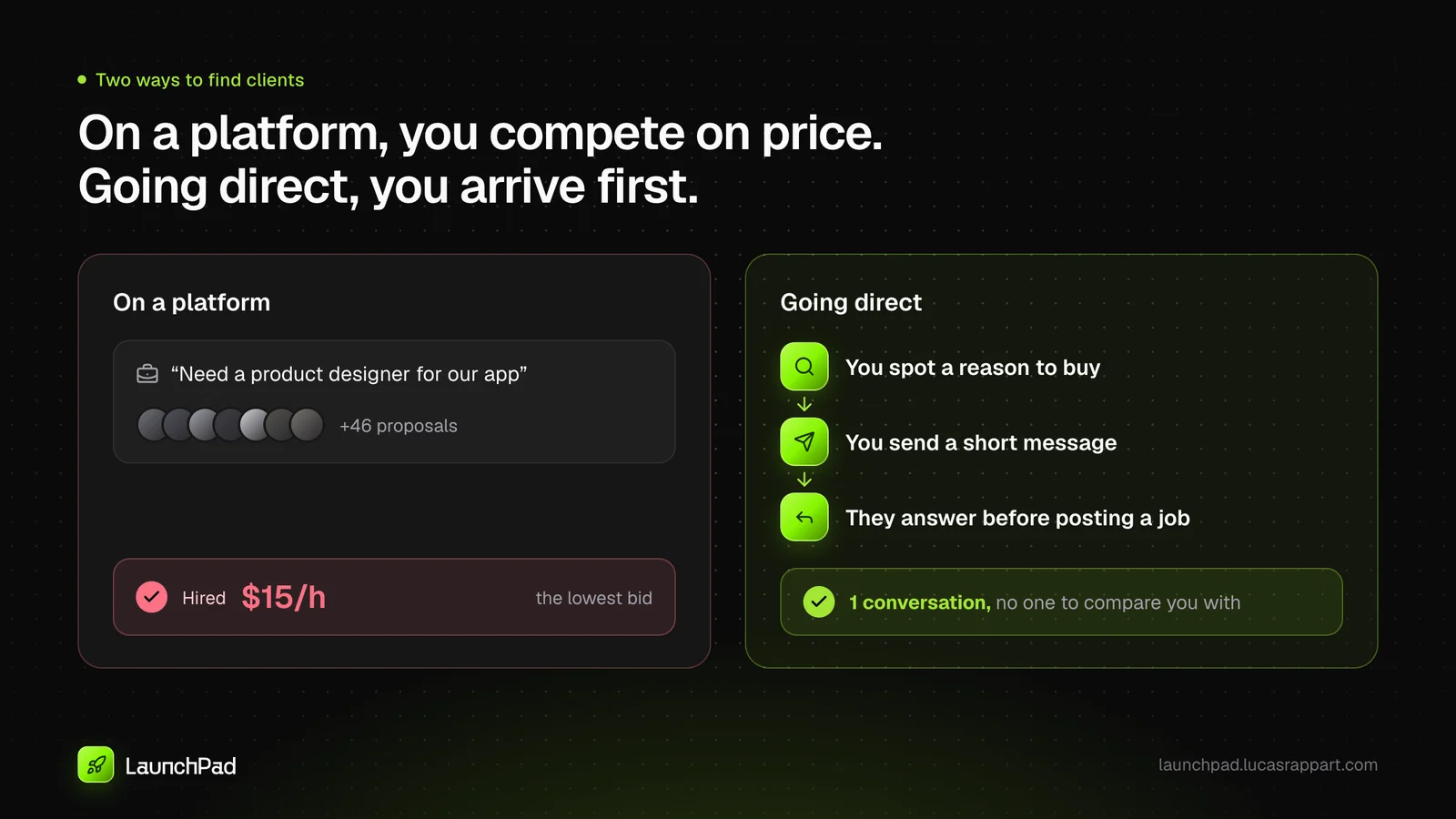
Platforms make you compete on price. Here is a simple weekly method to find product design clients directly, in about 30 minutes a week.
Most freelance product designers find their first clients the same way: friends, ex-colleagues, a lucky referral, and a profile on a platform. It works for a while. Then a project ends, nothing comes after it, and you open Upwork again.
The problem with platforms isn't that nobody hires there. It's that everyone else is there too. A client posts a project, receives dozens of proposals in a day, and the easiest way to choose is the price. You end up competing with hundreds of designers on the one thing you don't want to compete on.
There's a quieter way: go to the clients before they post anything. It takes four steps, and about 30 minutes a week once it's running.
Step 1: pick one buyer
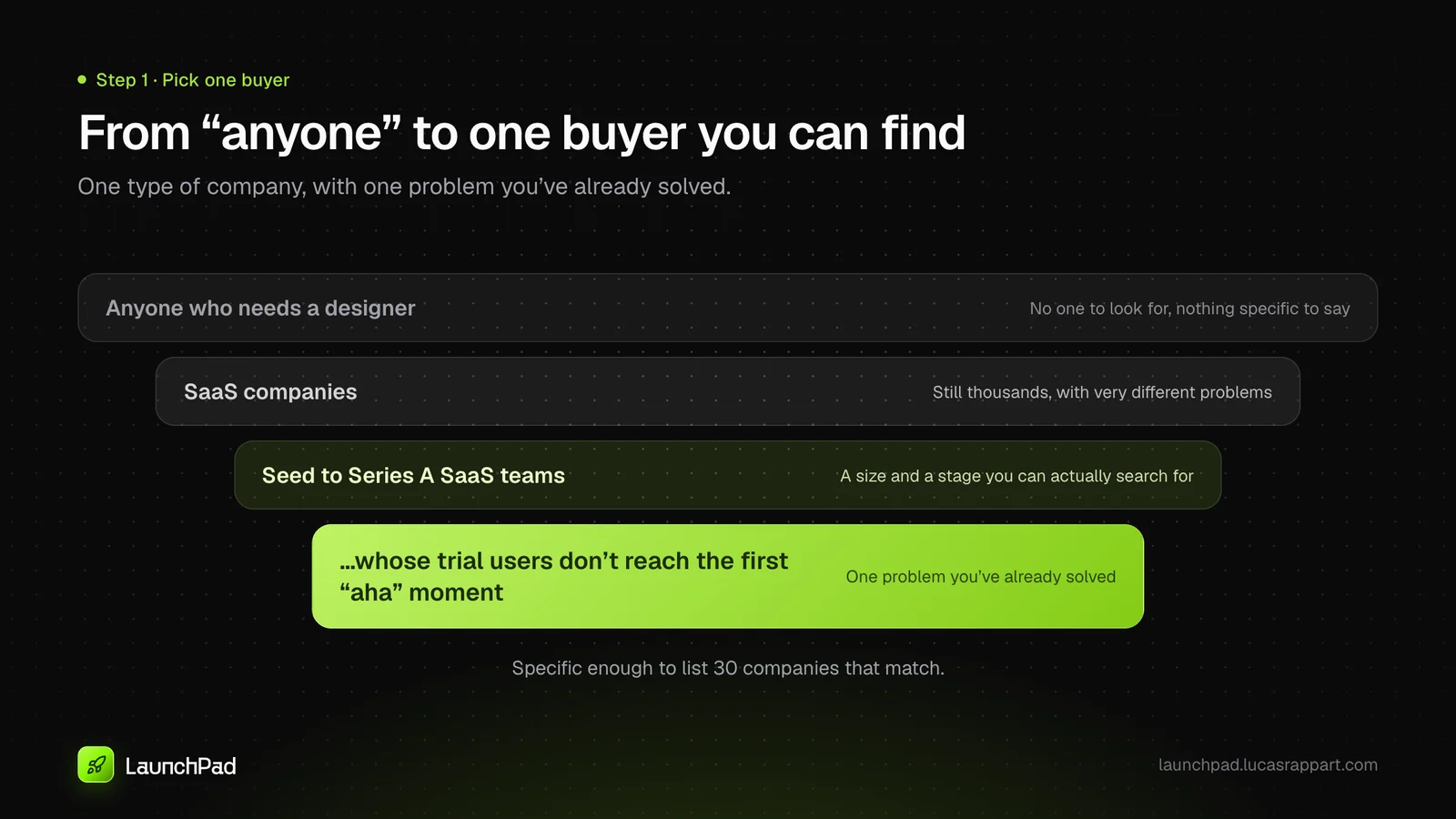
"Anyone who needs a designer" isn't a target. It gives you nobody to look for, nothing specific to say, and no reason for a company to pick you over someone else.
A buyer is one type of company with one type of problem you've already solved. To find yours, look at your past projects and ask:
- Which projects did I do my best work on?
- What kind of company was it (size, industry, stage)?
- What problem were they paying to fix?
- Who signed off on the project?
You're looking for a line like: seed to Series A SaaS teams whose trial users don't reach the first "aha" moment. Not perfect, just specific enough to find 30 companies that match.
Not sure which buyer to pick? It's the question that comes up most in my sessions. A free 15-minute diagnosis is often enough to narrow it down.
Step 2: look for a reason to buy now
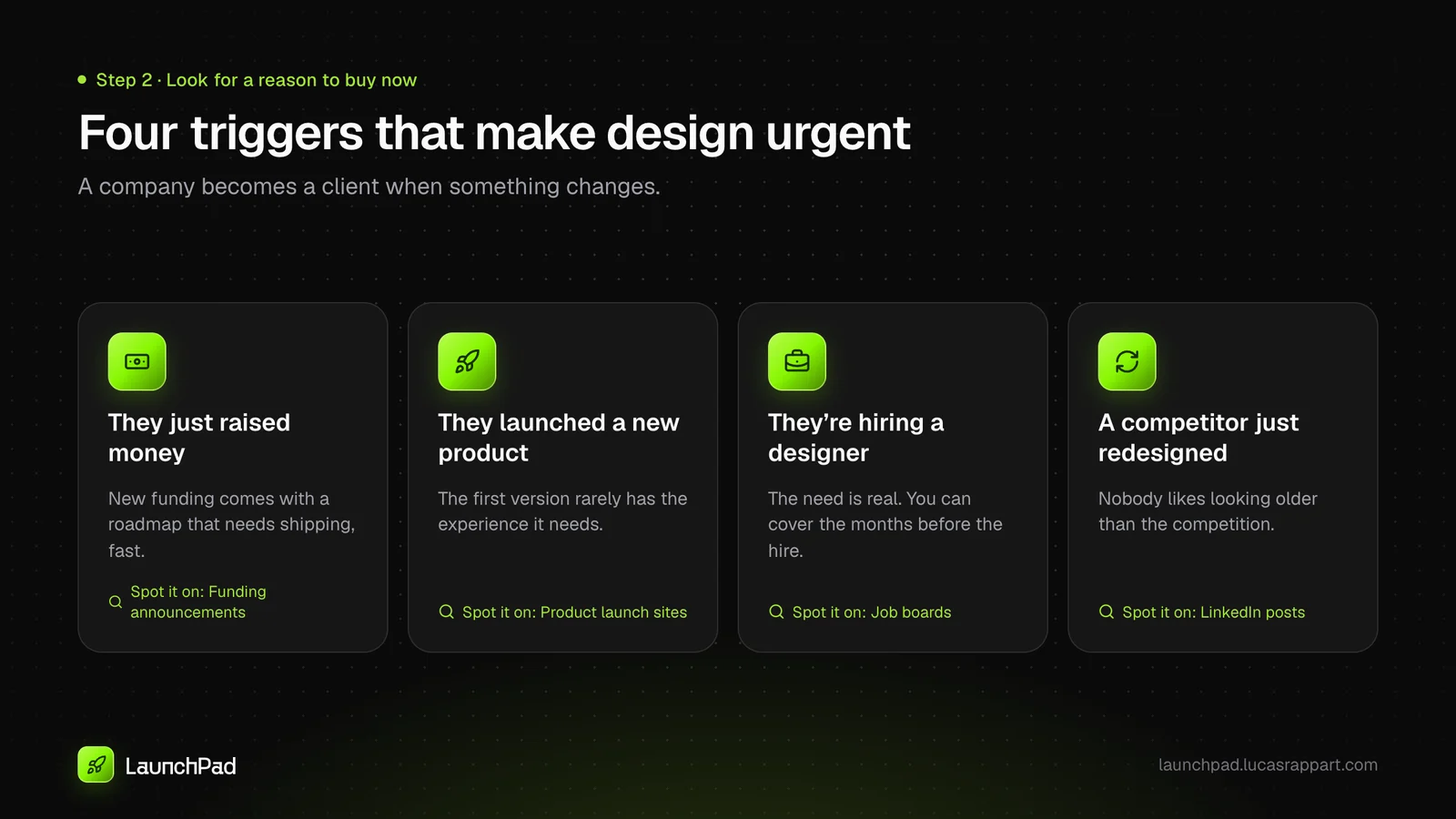
A company in your target isn't automatically a client. It becomes one when something changes and design becomes urgent. These are the triggers worth watching:
- They just raised money. New funding usually comes with a roadmap that needs shipping, fast.
- They launched or announced a new product. The first version rarely has the experience it needs.
- They're hiring a designer. A job post means the need is real. A freelancer can cover the months before the hire, or the work the hire won't get to.
- A competitor just redesigned. Nobody likes looking older than the competition.
You can spot most of these in a few minutes: funding announcements, product launch sites, job boards and LinkedIn posts from founders and product leads.
A trigger changes the conversation. You're no longer a designer asking for work. You're someone who noticed something happening and knows how to help with it.
Step 3: write a short message about them
Most cold messages fail for the same reason: they're about the designer. The portfolio link, the years of experience, the list of services. The reader has to do all the work to figure out why it matters to them.
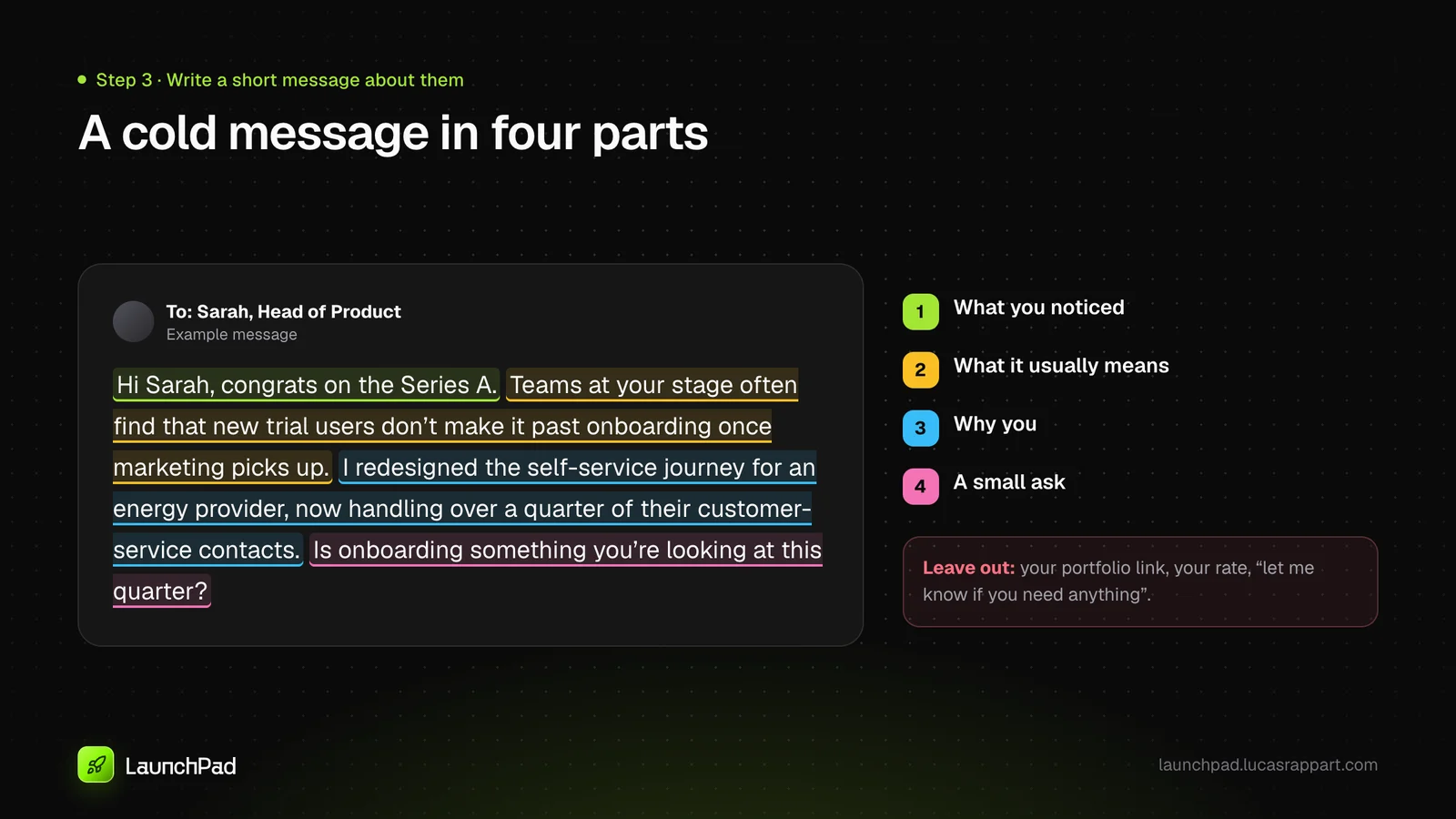
A message that gets answers is short and starts from their side. Four parts:
- What you noticed: the trigger, in one line.
- What it usually means: the problem that tends to come with it.
- Why you: one line of proof, ideally a similar project.
- A small ask: a question that's easy to answer, not a meeting request.
Here is an example (illustrative, not a real message):
Hi Sarah, congrats on the Series A. Teams at your stage often find that new trial users don't make it past onboarding once marketing picks up. I redesigned the self-service journey for an energy provider, now handling over a quarter of their customer-service contacts. Is onboarding something you're looking at this quarter?
No portfolio attached, no rate, no "let me know if you need anything". If they're interested, they'll ask.
Before you send that first message, it helps to know your floor: the day rate you won't go below. The free day rate calculator does it in a couple of minutes.
Step 4: make it a 30-minute weekly routine
The method only works if it runs every week, including the weeks you're busy with a project. That's the whole point: when the current project ends, the next conversations are already going.
The routine:
- Same day, same time, 30 minutes in your calendar.
- Find 3 companies in your target with a trigger.
- Send 3 short messages, one per company.
- Follow up once on last week's messages, a week later, with something useful rather than "just checking in".
- Keep a simple list: company, trigger, date sent, reply.
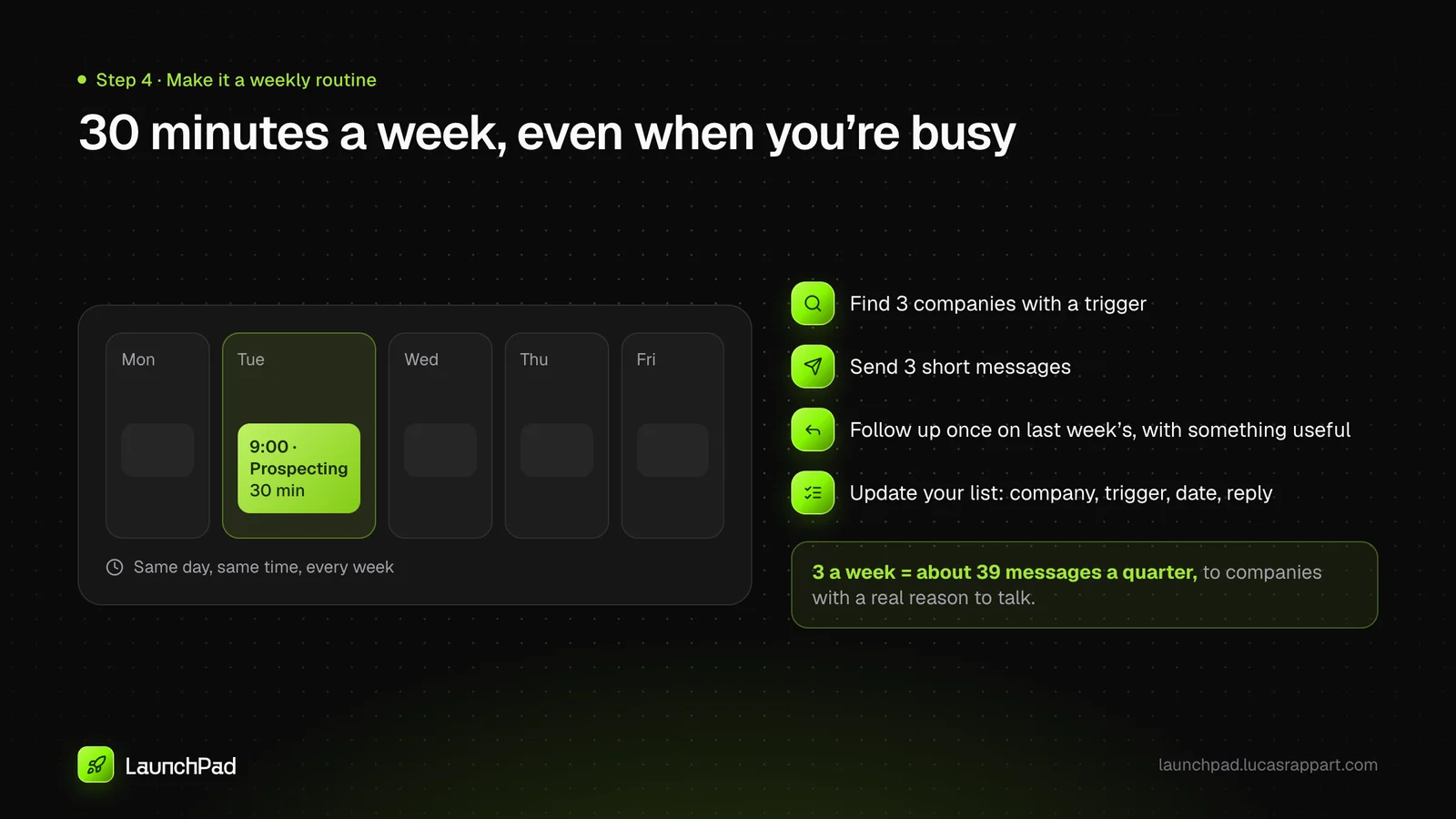
Three messages a week doesn't sound like much. Over a quarter, it's dozens of conversations with companies that had a real reason to talk to you.
The mistakes that stop it from working
- Prospecting only when work runs out. By then, every message carries the pressure of an empty calendar, and new clients take weeks to say yes.
- Talking about yourself. Your skills matter, but only once they're connected to their problem.
- Never following up. Most replies come after the second message, not the first.
- Targeting everyone. Without one buyer, you can't spot triggers, and your messages stay generic.
Where most designers get stuck
The method itself is simple. Where most designers get stuck is applying it to their own situation: picking the right buyer from projects that all look different, finding the triggers in their market, writing a first message that doesn't sound like everyone else's.
One designer described the session like this:
"His attentive listening enabled him to tailor a concrete plan for me to kickstart my journey in building a strong client base as a new freelancer." — Uzochukwu Okafor, Freelance Developer & Designer
If you'd like a second pair of eyes on your case:
- Free diagnosis, 15 minutes: we name what's really blocking you.
- 1:1 coaching session, one hour: we work on your buyer, your triggers and your messages, and you leave with a written plan.
Get the next article by email
Pricing, positioning and finding clients, from my own client work. One email a week, nothing else.